Showing posts with label indian state. Show all posts

Sunday, April 26, 2026

Four Level View Of Systems By Shankara Bharadwaj Khandavalli


Abstract 

This paper proposes viewing all systems in four levels – worldview, doctrinal, institutional/architectural and experienced/lived reality. 

We draw upon the axiomatic sources of Indian knowledge to bring this perspective, and explain how the design of systems in India has been enlightened by such perspective. 

Such a perspective applies to all systems manmade and cosmos, as per Indian knowledge. By corollary, it is visible in the design of collective institutions such as state, social institutions, religious institutions etc. 
We then draw a contrast with the modern institutions and the texts underlying them, and how these four levels are implicit or explicit. 

We argue that taking cognizance of such a perspective results in a systematic design of texts underlying institutions, and the architecture of texts would be very different from the modern texts that lack such a perspective. 

Its primary implications are in 
a. the way futuristic knowledge generation and theorizing would happen, and how various fuzzy and 
complex activities involving institution design for large societies can be made systematic. 
b. the way these subjects can be brought into a more rigorous formal epistemic structure. 

Introduction to the Concept 

The Puruṣa Sūkta of Rig Veda is one of the best expositions of cosmic views, and it is said there - 
pādosya viṣvā bhūtāni tripādasya amRtaṃ divi” 

Meaning, all the visible world is one fourth of the four-fold divine, the other three remain immortal. They are visible only to the trained eye. 

In many ways, this applies to systems manmade and cosmic, in a simple cause-effect sense. The visible is but an effect, whose cause is visible only to the trained eye. This is a fact that is universally verifiable. It can be the workings of a scientific theory whose results are visible to the common man, it can be the efficiency of a machine whose workings are unknown to the user, it can be the social outcomes of a theory of state, it can also be the visible universe itself whose evolution and workings are unknown to a good part. What appears magic to the untrained eye, is yet something quite meaningful for the trained eye and only more meaningful for the trained hand that is working this “magic” to bear fruit to the ones experiencing the fruits. 

Puruṣa of this Sūkta is the primal cosmic being, the personified representation of the cosmos. He is the performer of the grand cosmic sacrifice, and also the whole of the sacrifice itself. 
Contrary to the view that Upanishad contains the “summary” of Vedic knowledge, it can also be argued that Upanishads contain elaborate commentary of what is summarily mentioned in the Samhita portions.
 
“Ekam Sat” (Rik 1.164.46) is one such brief statement of Samhita which has elaborate descriptions in the Upanishad. Another is the above Rik that mentions fourfold cosmic being. Its nature is found in the Mānḍūkya Upanishad, where the three immortal layers are enunciated along with the fourth and manifest. 

Four Levels and Four Parts 
The four parts of Puruṣa can be seen as correlating to the four parts of divine/cosmic being enunciated in Mānḍūkya Upanishad. The being that consumes gross, subtle, causal objects in three levels and remains immutable in fourth (eternal/composite). 

Mānḍūkya Upanishad (verse 2) says 
“sarvaṃ hyetad brahma, ayamātmā brahma, sothamātmā catuṣpāt” 
Meaning, all that is existent, is Brahman. The self is Brahman too (thus micro is a reflection of macro).
 
And it is four-fold. The subsequent verses detail that the first part is Vaisvanara the enjoyer of gross objects, second is Taijasa the enjoyer of subtle objects, third is PrAjna the enjoyer of causal objects and fourth is the composite/eternal/absolute. 

These four correspond to the manifest outcome (gross, lived experience), the how/mechanism/workings (subtle), the doctrinal/causal what and the fourth of macro perspective/eternal/existential reality. 
The gross is the most manifest level that is experienced, seen with “naked eye”, in case of collective phenomena the “ground reality”. From this level of experience, the universe appears as it is to the naked eye, or “viṣvā bhūtāni”of Puruṣa Sūkta. The universal being at this level of experience is the vaiśvānara of Mānḍūkya. Thus, this is the ultimate outcome/effect whose cause lies in the others. 

The subtle is the level of mechanism of how things are done and how they work. In the workings of any system, this is the layer of architecture/institutional structure. This is the cause of the manifest fourth layer, and it is caused by the workings of other two layers. In case of the cosmos, the laws of nature, the intelligence that causes the dynamics of cosmic action, in other words the mechanisms of setting cosmic order constitute this layer. Institutions work their magic by channeling the collective energies towards specific outcomes, favoring certain outcomes over others. These outcomes appear simply as results of actions of the acting entities/members, yet when one refers to the “system” it is this structure that one refers to implicitly. 

The causal is the level of principle and purpose. In case of cosmos, the primal causal principle or the “purpose towards which the whole game is being played”, is the source of such doctrine. In any system, this corresponds to the doctrine underlying institution design. The primary principles which are meant to be served by the institutional structure, remain the purpose for which it is designed. Thus the causal/doctrine is the cause whose effect is the subtle/architecture. 

The fourth is the level of existential reality. In cosmic sense this is the absolute. In any system, this is the worldview, an ontological statement of the nature of the essential reality. “It is because the essential reality of man is such, that he craves such things, thus to serve his collective purpose such an institution would be an ideal vehicle”- thus proceeds the thought process of an ideal system design. 

The table below summarizes the four level view. 


State, Constitution 
The four level view is best demonstrated with the example of constitution and statecraft. 
The laws, policies, executive actions instruments etc are in fact the manifest fourth leg of statecraft, outcomes of the exercise. What underlies these, is an institutional structure, an architecture of state that makes the various entities in the system operate in a certain way, with specific objectives and incentives motivating those actions. 

This is the “invisible” third part of the system, which is not really something that is paid attention to by the user of the system or even a diligent participant in the functioning of the system, and is known only to a discerning participant in the design of the system. 

This institutional structure determines which aspect of the system weighs more powerful in which aspect, which kind of policies can be enacted by it, what its strengths are and what its limitations are. In this sense, this is the cause whose effect is the manifest and experienced outcome of actual functioning of the system. In fact a good system is one where the institutional structure itself does not become overtly visible or felt, but the country functions because of it. The structure will be felt when its baggage or inefficiency shows, otherwise society is oblivious to it for the most part. 

Underlying the institutional architecture is a doctrine, which acts as a set of ideals that the state aspires to realize. The institutional structure, policies, incentives all are directed towards realizing the ideals derived from the doctrine. For instance, equality and justice, welfare of society, promoting fraternity are all ideals that constitute part of the state doctrine. 

The doctrine thus, is the second part of the system, the cause whose effect is an institutional structure. 
Underlying doctrine is a worldview, from which a doctrine derives. The nature of man and world, purpose and goals of human life, means to their fulfillment, nature of collectivities etc constitute worldview. The state doctrine and goals are determined based on worldview. For instance, if goal of human life is fulfillment of potential and highest happiness, enabling humans towards that happiness becomes the goal 
of state, a state doctrine. On the other hand if fulfillment of needs is defined as the enabler of happiness, then goal of state would be to help fulfill human needs – and the state becomes a welfare state. Thus worldview is the cause whose effect is the state doctrine. In cases where worldview is stated and established, there is a way to systematically derive the doctrine and change it with time, with respect to 
a worldview. In cases where it is unstated, changing a doctrine would mean a full reset of system since there is no basis remaining for evolutionary change. 

In the modern constitutions there is no clear layering of content into these. Worldview is mostly assumed and unstated. Doctrine is where modern constitutions begin. Whether it is “that all are created equal” of US constitution or the aspiration of equality fraternity etc in Indian constitution, the ideals are stated axiomatically. 

This in itself may not concern civilizations that have seen revolutions to bring about change in ideals. But revolution itself is a civilian trauma, and the need for it is a fundamental failure of system in Indian view. 
A society that is capable of evolving systems organically, by changing what is temporary and basing it on a substratum of unchanging principles of nature, would not treat ideals axiomatically but as temporal. 
Ideals of state have changed over time with human evolution. 

So a more scientific approach to this is to make an explicit statement of worldview, part of it being axiomatic (and derived systematically from axiomatic sources to ensure probity in the statement of worldview) and part of it derived from it and established as a translator for establishing doctrine. 
From this, doctrine derives systematically, in a way it suits temporal requirements. Doctrine thus becomes refutable instead of axiomatic. State architecture or institutional structure derives from doctrine and that remains prescriptive, similar to modern constitutions. However, there needs to be refutability in it – to show how an institutional structure realizes the doctrine and how change will be prompted by non- 
realization. 

Thus we have ontological, normative, prescriptive content in the text of statecraft, and not limited to prescriptive content. It is not necessary that all the types of content are in the same document either. But the classification needs to be in a way that consistency and completeness are not violated. Worldview is visible, at the level of lived reality, through the doctrine and institutions. For instance if man is an 
economic being in a worldview, the entire system is designed in an economy-centric way. If purpose of life is highest happiness in a worldview, the entire system is designed to enable what man seeks without judging or measuring him in economic terms. 

In traditional Indian scheme, the worldview and part of doctrine are found in dharma śāstra (Manu Yājnavalkya Parāśara Devala etc). Institution design is only in principle dealt in dharma śāstra. Part of doctrine and institutional structure, instruments of state etc are visible extensively in artha śāstra (Kautilya’s Artha śāstra, Nīti Sūtras, Sukra Nīti Sāra etc). It can be seen by studying them together, that 
artha śāstra is giving instruments to fulfill the goals laid down in the dharma śāstra. After all, “ dharmasya mūlaṃ arthaḥ” or artha is the means to fulfill dharma. 

Such an architecture brings permanence to a grand design, where structures remain temporal and new ones continuously emerge to replace older ones, without needing revolutions for such replacement. That change happens is not a cliché but has to be visible in the way a system is designed. Taking explicit cognizance of this four level view helps us design systems where change is organically embraced at all 
levels. To specify a worldview means that if that layer changes, all the other layers will change to adapt to it. Change in doctrine means there is no change in worldview, and the two lower layers will change. If doctrine remains the same and institutional structure is unable to keep up to realize it, it means there needs to be a more current design and it will mean change at two levels by keeping two unchanged. The 
fourth or lived experience of it always changes, and is the ultimate test for the success of the system. 

Applicability 
It may appear that the Puruṣa Sūkta mantra is indicating the four parts of divine and invisible, and that in case of state all four are manmade. However it needs to be understood that these are four levels of any system – the cosmos too. Divine or otherwise, the “institutional structure” of the universe is explained in 
the śRti. This may or may not be subscribed to in a particular worldview, but in the Astika scheme this remains the cause whose effect is lived reality and experience of beings. Principle of action, yajna, transcendence, guna, are all constructs that govern the experiences/lived reality. 

What becomes doctrine is the dynamics of creation of world, the intelligence principle behind it. 
Viṣṇu is said to have created three worlds and established “dharma” or the order of functioning. This constitutes doctrine. 

Worldview as known to humans is darsana. As known to divine, is only known to human in little bits. 
It is said “yathā pinḍe tathā brahmāṇḍe”, what is applicable at macro is also applicable to micro. This is also the basic principle that yoga and spiritual philosophies base themselves on. It is not limited to seeing and realizing the entire universe manifested in individual being as a microcosm, it also very much applies 
to how human collectivities operate by the same principles of nature that are found in the seeds of creation. The collective being, social at one level is cosmic at another. This is also why the divine who expounds Herself in VāgāmbhRṇī sūkta, revealing Herself as manifest in all the devatas like Indra and Vasu-s, also calls Herself the social collective whole - Rāśṭrī. 

Table below summarizes the four level view of state and its root texts


Society 
In India, society has a matrix of institutions (discussed in the paper Scope of Smriti and Nature of Dharmic State) that are stratified and non-hierarchical, and orthogonal to the hierarchical institutions of state. 

They are designed very much by these four levels. In the world view layer come the permanent nature of world and man, macranthropy (cosmos as a personified divine), varna dharmas (which are common to all forms and beings not just humans) etc. They are codified in the axiomatic sources and sanātana/eternal layers of dharma śāstras. 

At the doctrine level there are dharma’s operating layers including temporal/yuga dharma, primary principles of life, basic tenets of sampradāyas. Doctrine derived from worldview of triguna and Ananda as purpose of life, so that institutional structure is designed to be a vehicle for its fulfillment. 

At the architectural level the various institutions like deśa, jāti, vṛtti, ecosystem of sampradāyas are visible, which operated to provide cohesion and acted as vehicles for fulfillment of human purposes and realized the doctrines. 

The lived reality is the outcome of these, which reflected in a high civilization, prosperity, perfection, lofty human conduct, integration motifs working across Bharata. While the destruction of these institutions over centuries under external attacks was a matter of time, it is not the vitality of institutions in the long term but the relevance of their principles for the future that matters, so that newer institutional structures 
can be designed. 

Below is the table summarizing the four levels in context of institutions of social collective. 


Religion 
Religion and spiritual philosophy is a sphere where the four level view shows marked difference, and how evolution is enabled or preempted through institutional structure, as a result of the worldview adopted. 
The table below summarizes how the manifestation happened from a worldview to lived reality in dharmic and abrahamist spheres. A lot of this is known reality and hardly needs argument, so it is stated in the most brief way possible primarily to indicate the manifestation level and causation through the levels rather than to indicate the good/bad. There is definitely a bias visible in the presentation, in favor of better articulated knowledge over a faith system, in favor of one that has a stratification between ontological, normative and prescriptive forms of texts. 

Conclusion 
To conclude, taking cognizance of this enables design of lasting institutions that have the capability to evolve and be replaced organically in a non-violent and inexpensive way. The substratum of a permanent worldview which can be rearticulated in an effective way to suit times, enables revision of doctrines and revision of doctrines means scope for rearchitecture without needing violent and costly revolutions or 
resets of civilization. The modern world is now at a stage where it can start contemplating on such possibilities, given the recent tryst with enlightenment ideals and having achieved certain level of civilizational maturity. This possibility would not have been a serious matter to think of in the feudal or slave age, given the maturity levels of institution design and their alignment with higher human purposes. 
Today it is a possibility, to evolve such a four-level knowledge structure, and align design of future collective institutions based on those. If the eternal wisdom of India is to prevail in this matter, this possibility would become a reality. 

Texts and References 
1. Puruṣa sūkta, Rigveda 
2. Viṣṇu sūkta, Rigveda 
3. Mānḍūkya Upanishad 
4. VāgāmbhRṇī sūkta, Rigveda 
5. (Book) Hindu view of Christianity and Islam by Ram Swarup 1992 
6. (Paper) Scope of Smriti and Nature of Dharmic State, Shankara Bharadwaj Khandavalli 2017 
7. Dharma śāstra-s (Manu, Yājnavalkya), Dharma Sūtras (Apastamba, Baudhāyana) 
8. Artha śāstra-s – Kautilīya Artha śāstra, Nīti Sūtras, Sukra Nīti Sāra

Wednesday, December 6, 2023

Scope Of Smṛti And Nature Of A Dhārmic State – Part 1 - Shankar Bharadwaj Khandavalli

 Abstract

After independence in 1947 this is arguably the most opportune time for us to contemplate on a constitution and a state design that aligns best with the nation. Right from the notion of nation-state and union of states, to rights to ideals like equality to choice of democracy to secularism, the modern systems known were adopted in Indian constitution. There has not been an analysis or a debate of whether these align with Bhārata, there has only been an attempt to make these successful in Bhārata with an implicit assumption that Bhārata should scale up to these ideals of modern age. Whether it is on the basis of a theory of polity or morality or social design, the choices never went through enough scrutiny. Today we have both the experience as a nation and the record of post-independence state institutions to make such an evaluation.

To be able to have a constitution and a state that best aligns with the nation, it is necessary to look at the notions of constitution, state, nation, morality and ideals as Bhāratīya-s understood for ages, how they evolved, and which of those were behind our glorious past, which of those need what level of adoption. Great nations can’t be built by a welfare state that focuses on lower functions of human consciousness (including wealth distribution). Great nations are a result of higher functions of human nature, of the highest level of human fulfillment, living the loftiest ideals and realizing the highest human experiences. We are a great civilization and a great nation built by Rāma, Kṛshṇa, Ṛshi-s and Devata-s, and we need a smṛti and a rājya that espouse their ideals to rebuild ourselves from the colonial shadows into glory.

The primary focus of the present paper is to present the scope of smṛti and the nature of a dhārmic state. We attempt to make a contrast with the present constitution and nation-state, not with focus on a comparative analysis or critique of the present system. Most of the present day ideals and notions are assumed and taken for granted and this makes it necessary to present a contrast before the true nature of a dhārmic state and smriti can be understood, unbiased by such assumptions.

Such an exercise would begin with a comparison of the foundational texts of collective organization, the smṛti-s of traditional Bhārata with the Indian constitution. The bases for comparing and contrasting a Bhāratīya smṛti with Indian constitution do not merely happen to be ideals or policies. Comparison needs to be of the very bases of the texts and their scheme, the worldview and principles that form the basis for those ideals and policies, the collective organization and manifest results of implementing those ideals and policies in the nation.

This exercise involves multiple challenges. Primary challenge is that there is no clear epistemic basis for such evaluation. For instance, modern constitutions assume several ideals that are not refutable within the framework of constitution. The ideals themselves have to be refuted outside the framework of constitution, while the policies assuming those ideals need to be debated within the framework. In contrast a smṛti text spells out an ontological basis from which its ideals emerge and the source texts that form basis for the axiomatic content of the smṛti. In fact this feature is common to most Bhāratīya texts – there is always a meta content available based on which content could be modified or codified. For instance aṣṭādhyāyi is not a grammar text written in Sanskrit but in upadeśa, a meta language. Similarly smṛti is not directly a constitution or a book of law but includes meta text that enunciates guiding principles for framing such books. The constitution and smṛti are thus texts at different levels, one gospel-like and the other refutable.

In brief, the paper contrasts the salient features of present constitution with a traditional smṛti. Broadly these features are of two kinds –

  1. Document level features: These include meta content that contextualizes the core content of the document, helps audit, internal consistency and updates, manages the multiple layers of content in a non-conflicting way.
  2. Content level features: These include the universal principles, scheme of morality and ontological bases of the text; considerations such as permanent-temporal and micro-macro underlying the design of institutions; the nature of nation as the text sees it and the nature of state designed by the text.

We propose how a constitution would structure itself, if based on dharma and Bhāratīya principles of constitution and law making. This includes the nature of dharma, multiple layers of text in a smṛti, such as the eternal, temporal, region specific, multiple aspects of the content of the text. There is far little emphasis on political model and executive since they become corollaries and emerge as a result of a right understanding of rāshṭra and dharma śāstra. The primary focus is on how the meta content determines the nature of state and society. The orthogonality of geo-political (state/rājya) and geo-cultural (nation/rāshṭra), the principles underlying various institutions and the bases for their formation and evolution rather than the institutional structure itself, will remain the focus. The considerations in a constitution that explicitly and implicitly allude to the different aspects of the nation and society, their relative significance and insignificance in different layers of the text becomes a secondary focus. For instance, how the assumption of a diverse society results in constitutional provisions as compared to the assumption of a monolithic religious society.

We attempt to present the nature of a dhārmic state that bases itself on such a smṛti. Some of the principles of a dharmic state (such as prajāranjakatva &śikshā dakshata, yāthā rājā tathā prajā etc.), and their influence on policy and law making are identified. Instances from the manifest layers and policies are used more as examples to explicate the point rather than as an attempt to demonstrate the merit of a policy. Some of the problem spaces such as the trade-off between civil liberties and state authority, social order and identities, integration motifs in the institutions, the way they get formalized in a constitution are identified. It is also identified, for completeness, what does not form part of a smṛti and what forms part of a temporal executive.

Introduction

After independence in 1947 there was an opportunity for us to create a constitution and design a state that aligns best with the nation. However, we have adopted a colonial state with little criticism of ideals and institutions, while amending the aspects that appeared coercive in the colonial state. Right from the notion of nation-state and union of states, to rights to ideals like equality to choice of democracy to secularism, mostly the modern systems known were adopted in Indian constitution. There has not been an analysis or a debate of whether these align with Bhārata, there has only been an attempt to make these successful in Bhārata with an implicit assumption that Bhārata should scale up to these ideals of modern age. Whether it is based on a theory of polity or morality or social design, the choices never went through enough scrutiny.

It is therefore necessary to evaluate the ideals of modern Indian state, their suitability and their bases, with Bhārata, her ideals, notions of nation, individual and collective morality forming the frame of reference. Only then could one arrive at the right set of ideals and institutions best suited for the abhyudaya of Bhārata.

Such a contrast could start by comparing the foundational texts of collective organization, the smṛti-s of traditional Bhārata with the Indian constitution. The bases for comparing and contrasting a Bhāratīya smṛti with Indian constitution do not merely happen to be the ideals or policies. Comparison needs to be of the very bases of the texts and their scheme, the worldview and principles that form the basis for those ideals and policies, the collective organization and manifest results of implementing those ideals and policies in the nation.

This exercise involves multiple challenges. Primary challenge is that there is no clear epistemic basis for such evaluation. For instance, modern constitutions assume several ideals that are not refutable within the framework of constitution. The ideals themselves have to be refuted outside the framework of constitution, while the policies assuming those ideals need to be debated within the framework. In contrast, a smṛti text does not base itself on assumed ideals but spells out an ontological basis from which its ideals emerge and the source texts that form basis for the axiomatic content of the smṛti. Smṛti is not directly a law book or constitution, but is multi-layered and has meta content that enunciates guiding principles for framing such books, along with sections of specific content that is modifiable based on the former.

Layout

To be able to examine the scope of a smṛti and the nature of a dhārmic state, the paper is divided into sections that;

  1. Draw a brief contrast of constitution from a traditional smṛti to indicate the structural and conceptual differences.
  2. The moral scheme underlying a smṛti.
  3. A structural and institutional view of Bhārata, the notions of state and nation.
  4. Briefly contrast traditional institutional structure from nation-state.
  5. Explore how a constitution would structure itself, if based on native principles of constitution and law making.

Constitution

The constitution of a nation gives an idea of how a nation views herself, her identity and her cherished ideals. Constitution at least in the present sense, while broadly identifying the nation and indirectly referring to nationhood, defines a state that governs the nation, ideals of state and a framework of rights. While some of these are universal in nature, the state’s commitment towards nation and her identity, her cherished principles and ways of life, is almost assumed. Laws are derived from these ideals and rights, towards protecting/achieving those.

However, this structure itself is a relatively modern evolution. The traditional constitutions in India, the smṛti-s, are structured not to begin with defining a state but from universal-eternals, then explaining human nature, then the bases for defining a state, and the land where the law of land applies. The structural difference between the foundational documents is equally important to understand as the difference in the content, since such difference is also directly related to the macro aspects of how those documents see the world, man, nation, state.

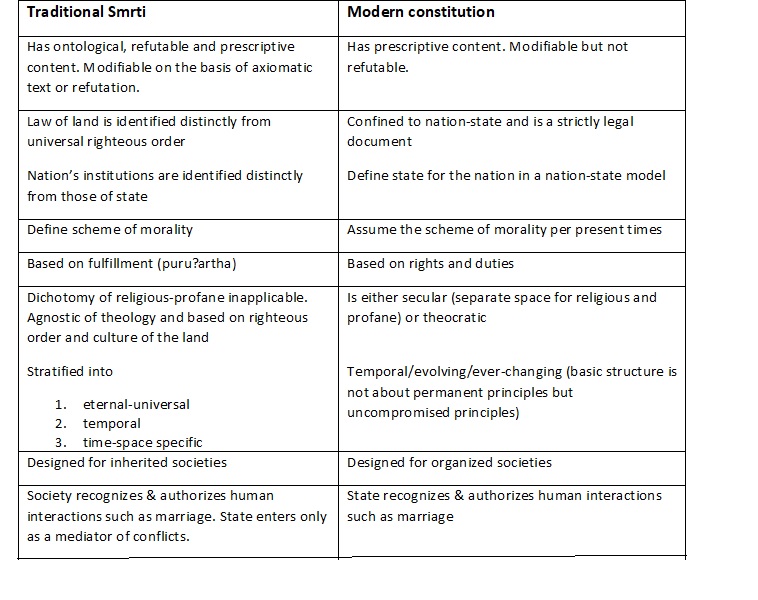
Table 1 depicts a high level contrast between smṛti and constitution. Smṛti first engages in explaining the universals, then the specifics of human nature, and the bases for making laws as rooted in those. A scheme of morality is first spelt out even before law is made. Constitution in contrast, spells out the ideals for a state but does not spell out a moral scheme based on which the laws are made.

Broadly, it could be claimed that a smṛti is best designed for inherited societies whose main features are (a) a stream of knowledge traditions (b) an institutional structure that is adaptable and evolutionary. In contrast, a modern constitution is best designed for an organized society where state deals more directly with individuals.

Constitution defines a framework of rights and enlists the rights of individuals that are protected by the state. That rights are subject to state granting those, is implicit in this. In a smṛti there are no individual rights specified, one’s liberty is unbound until it is breaching a law or violating others’ natural liberties. This is vastly different from the notion of right, because rights are granted and protected by state whereas individual liberties are protected and determined by one’s own nature and conduct where the state’s role is passive. The seeds of individual action and human fulfillment through action – individual and collective are sown right in the dharma śāstra-s, as the cherished ideal of the Indian peoples for ages. This, thus, is a nation made by people – not as a euphemism but the way this nation defined herself. Fulfillment of being, through action, through fulfillment of desires and achievements, through inaction and through diverse experiences of life, fulfilling the purposes of life, becomes the basis for defining what state does to protect these. The primal human aspirations are identified, whose legitimate fulfillment (in a way it does not infringe similar fulfillment of other beings) is an ability that nature confers on individuals – through individual actions, through collectivities.

Table 1 Contrast between Traditional smṛti and Constitution

Constitution should reflect an understanding of the characteristic features of a nation and define state in a way that the interests of nation are best served. On the contrary, against the above backdrop, the post-independence Indian constitution tries to define how the nation should be. Instead of defining a state that aligns with and protects the nation, it imposes notions that revolt against the basic nature of this nation. While the table above and sections below keep drawing the contrast between the nation-state envisioned by post-colonial constitution and a dhārmic rājya-rāṣṭra envisioned by smṛti-s, the focus of this essay is not to establish that the post-colonial constitution does not align with the nation. It is a given and natural that it does not align. It is also natural that our constitution and state cause damage to the nation and her institutional structure.

We limit the scope of this essay to anecdotes rather than elaborate data, mainly to convey the thought than to demonstrate it. To clarify, data is important and data does get debated in public discourse today, and there is no shortage of details. For instance, the bad side-effects of discriminative caste policies and politicization of caste, the logical inconsistency in a secular state controlling religious institutions of Hindus, unequal treatment of various groups while setting the ideal of equality are not without mention in the last few decades. There is, however a shortage of debate on the institutional structure and the worldview and concepts underlying that structure.

The contrast between the post-colonial and traditional systems is drawn primarily to take focus back to how we can rediscover ourselves sans colonial thought rather than attempting to quantify the damage.

Morality

A scheme of morality is the primary assumption of a constitution, something that it does not define but makes use of. Indian constitution was derived from western constitutions, many of the acts continued from British times. They are mostly based on Victorian Christian morality. Recent judgments observed the need to change these to a more recent, post-modern moral assumption such as decriminalizing LGBT etc. Many laws are called outdated because the ideals underlying these laws are changing with times.

There are collective ideals and individual morals. Constitution assumes both along the lines of western Christian view of man and world. The impact of this can be seen only when there is a contrast drawn with Hindu moral scheme (dharma), how it works and its implications in individual and collective life and lawmaking.

A proper contrast between Dharma and western morality can come not merely by comparing the moral frameworks of East and West, but by comparing the consciousness frameworks from where the human conduct (ethical or otherwise) is understood and explained.

Dharma

Nature can be understood through two of its primal aspects – consciousness quality (guṇa) and action (karma). Dharma or natural righteous order is determined by these two aspects. This is one of the foundational notions in Dhārmik systems, and is visible in the society, language, culture and view of life. Dharma as the goal of life is the fulfillment of dharma the natural order. Dharma or righteousness is not an imperative (like hypothetical or categorical imperative), but a purpose of life. Goals of life are four-fold, and fulfillment of being and attainment of complete happiness can happen through their attainment. Since dharma is the aligning principle of the nature of a being and its actions and thus its fulfillment, dharma is itself the first and foremost goal whose fulfillment leads to the fulfillment of the remaining three.

Fulfillment of purposes of life, attainment of happiness through the different faculties of consciousness (senses, mind, intellect, ego and the entire being) in a graded way is the basic theme in Sanātana Dharma. Attainment of happiness of the highest order (ānanda) is the end to which all human aspiration is, according to all the worldviews (darśanas). Dharma is natural righteous order which manifests in all beings, something existent and learnt from nature. It is the law which determines the experiences of beings and fruits of action. It is the basic law of cause and effect, on which the theory of karma is based. Dharma is thus the intrinsic nature of beings. And dhārmik acts like speaking the truth and being nonviolent, is the intrinsic nature of beings.

What becomes a “law” in dhārmik framework is something that is in the intrinsic nature of beings. Thus an “imperative” in Dharma traditions if one has to state, would be as simple as– “realize your true nature, be true to your nature”. This actually relates directly to actors, actions, situations and consciousness, and is not limited to stating moral facts. When there is a cosmic order that is pervasive and whose micro manifestation is the intrinsic nature, the order can hardly be subjective – it is universal by definition, while at the same time keeping in tune with the phenomenal diversity.

Nature and action are both rooted in consciousness. To understand dharma it is necessary to understand Indic consciousness studies. Consciousness study is a well-developed subject and influences most of the subjects, metaphysical as well as physical. Understanding consciousness qualities and consciousness layers/sheaths helps us understand the bases for concepts like Dharma too. In Hinduism the source of morality is consciousness itself, and manifests differently at different levels of consciousness. The dhārmik behaviour or morality is in the intrinsic nature of beings, and how dhārmik or adhārmik an action is, is determined not just based on a moral law but on the basis of the consciousness quality and the sheath to which the being belongs.

There are five sheaths of consciousness, which are grouped into three bodies of the being. The outer sheaths have to do with physiological needs, inner/deeper ones with psychic plane and still deeper ones with impersonal knowledge. Human evolution is defined in terms of increasing manifestation of the intrinsic nature and decreasing manifestation of outward nature. An easy way to understand this model is to map these sheaths to Maslow’s pyramid of hierarchical needs. Thus the outward nature of a being is driven more by needs (of the lower layers of Maslow pyramid or the outer sheaths of consciousness) and the intrinsic nature is driven more by urge for knowledge, aesthetics etc. (corresponding to upper layers of Maslow pyramid or inner sheaths of consciousness). So when we say the being’s intrinsic nature is to be truthful, it is because the object of consumption of intrinsic nature is truth-beauty (self-actualization and self-transcendence layers of Maslow pyramid) and not food-sense pleasure-ego gratification (physiological, survival, self-esteem layers of Maslow pyramid). So to speak the truth is the default intrinsic nature, which can be distorted by lower needs of man. We can apply the same logic to another moral fact – of nonviolence. While violence is an extrinsic natural fact and a basic survival method, and life sustains by consuming life, nonviolence still becomes a default in intrinsic nature.

The different aspects like morality, purposes of life, consciousness, happiness and excellence, epistemology and cosmic philosophy form part of a complex concept like Dharma which acts as the main guide of life in dhārmic worldviews. There is a common structure of knowledge and society in the east that reconciles and develops the several aspects of life and different forms of knowledge, and that is rooted in dharma.

Continued …….

Image credit: picxy

Courtesy: https://www.indica.today/research/raja-dharma-series-iv-a/

---------
*Updated : 2026